
Built for My Own Two Boys: Introducing Shape Explorer and Writing Practice
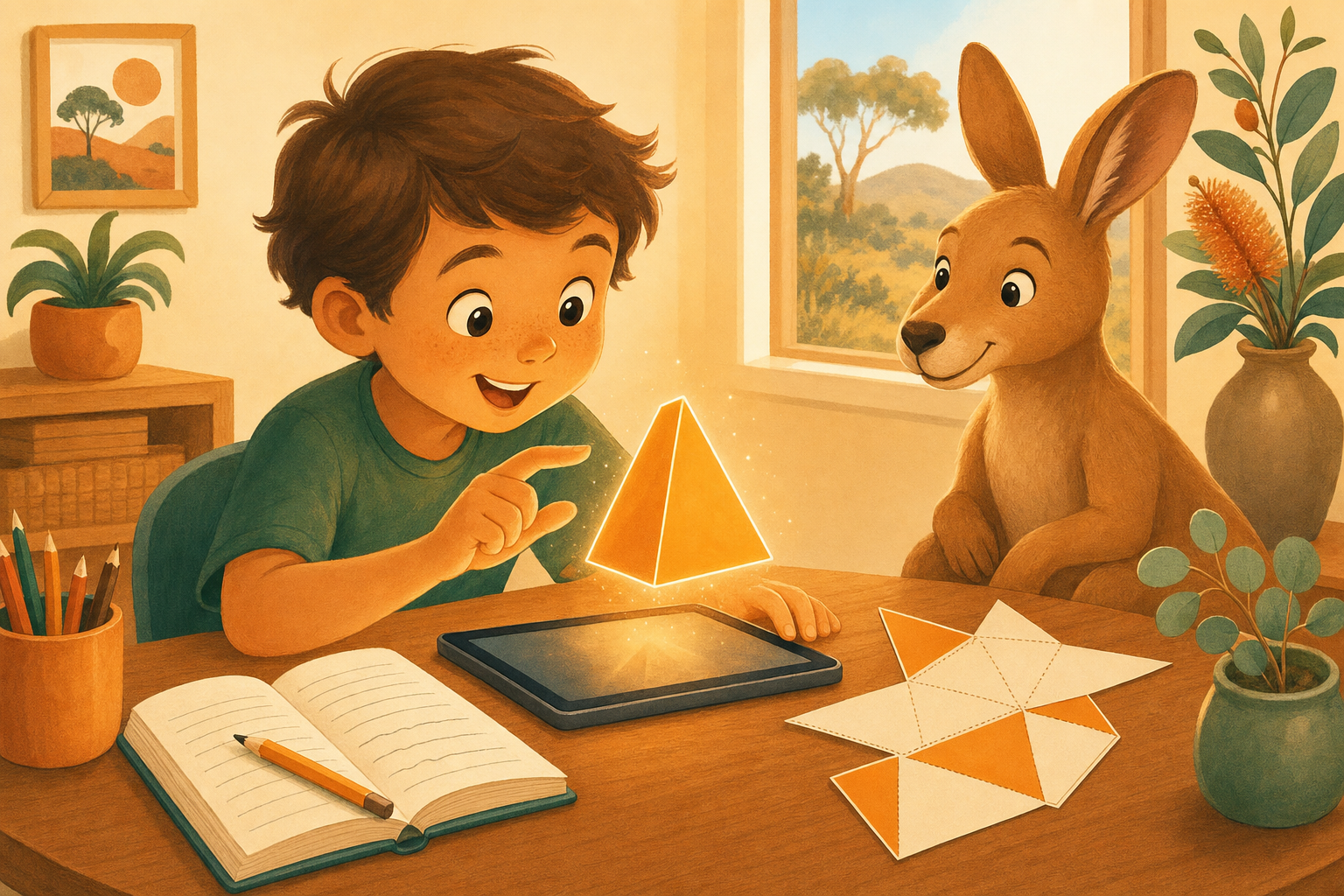
A lot of what we build into KangaQuiz starts at my own kitchen table. These two new features definitely did — one from my younger son, one from my older one.
I want to tell you the story behind them, because I suspect you've had versions of both moments yourself. The blank look when something just won't click. The slumped shoulders when a task feels too hard. And the quiet wish, as a busy parent, that you could be in two places at once — helping, explaining, reassuring — without having to drop everything every single time.
That's really what these features are for.
"But what is a triangular prism?"
My younger son was working through some shape questions and hit a wall. The worksheet asked about a triangular prism — its faces, its edges, its corners. He could read the words. He just couldn't picture it.
And honestly, why would he? A flat drawing of a 3D shape is a hard thing for a young child to decode. You're asking them to imagine depth, hidden faces, edges going "around the back" — all from a single fixed picture. Some kids get there quickly. Plenty don't, and it has nothing to do with how clever they are. They just haven't held the idea in their hands yet.
So we built Shape Explorer.
It's a 3D shape your child can actually turn. They drag to rotate it, pinch to zoom, and really look at it from every angle. Tap a face and it highlights, so "this shape has five faces" stops being a sentence to memorise and becomes something they can see and count for themselves. Best of all, they can unfold the net — watch the solid open out flat and fold back up again — which is the exact moment the penny tends to drop. "Oh! That's where the rectangles go."
For my son, a triangular prism went from a confusing word to a thing he understood in about two minutes. He turned it over, counted the edges, folded it flat, and moved on — no frustration, no me hovering over his shoulder explaining it three different ways.
Three-dimensional objects, their properties, and nets are right there in the NSW Mathematics syllabus, so this isn't a novelty — it's a genuinely tricky idea that the curriculum expects kids to grasp. Shape Explorer just gives them a friendlier way in.
When writing is the hard part
My older son's challenge was different. He's a capable kid, but writing made him freeze. Maths felt safe — there's a right answer, you find it, you're done. Writing felt wide open and a bit scary. Is this good enough? Is this what they want? Where do I even start?
What he was missing wasn't ability. It was feedback. A clear sense of what "good" looks like, and gentle, specific guidance on how to get a little closer to it. The trouble is, that kind of feedback usually needs an adult sitting beside them — and most of us can't do that for every paragraph, every day.
So we added writing practice to KangaQuiz.
Your child writes a response, and the app gives them feedback against clear, age-appropriate criteria — the kinds of things teachers actually look for, like ideas, structure, vocabulary and how well they've answered the task. It's pitched to their year level, too: we ask a little more of a Year 6 writer than a Year 1 one, so the encouragement always feels fair rather than crushing.
Crucially, the tone is kind. It celebrates what they've done well first, then offers one or two concrete things to try next time. That's the difference between feedback that helps and feedback that deflates. For a child who's nervous about writing, "here's what worked, and here's one idea to make it even better" is worth far more than a red pen.
It's practice and guidance, not a replacement for their teacher — but it means my son can have a go, see where he stands, and improve, all without having to stop and wait for someone to be free.
The thread that ties it together
Two different kids, two different problems — but the same underlying wish, and it's one I hear from parents all the time:
Let my child keep learning without getting stuck. When they hit a wall, they shouldn't have to down tools and wait for a grown-up. A shape they can turn, or feedback that arrives the moment they finish writing, keeps the momentum going.
Give them good feedback and guidance. Not just a tick or a cross, but the kind of "here's why, here's what to try" that actually builds understanding and confidence.
Let me, the busy parent, worry a little less. You can't sit beside them for every question — none of us can. But you can know they're practising with the NSW syllabus behind them, getting kind feedback, and that you'll be able to see how they're tracking when you next get a moment.
Because KangaQuiz quietly keeps track of how your child is going, you don't have to be in the room to stay in the loop. You can check in over a coffee, see where they're growing and where they'd like a hand, and let the day-to-day practice look after itself.
Try them with your own child
Shape Explorer and writing practice are live now in KangaQuiz, alongside our quizzes across Maths, English and Reasoning. If your child has ever stared blankly at a 3D shape, or frozen at a blank writing page, I'd love for you to see whether these help as much as they did for my two.
You can download KangaQuiz on the App Store and let them have a go today. No pressure, no countdown clocks — just steady, friendly practice that keeps the learning moving.
And if you try Shape Explorer with a triangular prism, ask your child to count the edges before they fold the net, then again after. The grin when it clicks is the whole reason we built it.
KangaQuiz aligns its practice to the NSW syllabus, which is set by NESA and can change over time. Writing feedback is designed to support practice and build confidence — it's a helpful companion to, not a substitute for, your child's teacher.
Practise for OC, Selective and NAPLAN with KangaQuiz.
Download KangaQuizKeep reading
How to Help Your Child Improve Their Spelling (Without Making It a Chore)
Simple, low-pressure ways to help your primary-school child become a more confident speller — plus free Australian spelling lists from Kindergarten to Year 6.

5 Signs Your Child Is Ready for Selective Practice
Wondering whether to start gentle selective-school practice? Here are five down-to-earth signs your child might be ready — and how to nurture that readiness without any pressure.